Thursday, August 10, 2017

How to Design a Hexcrawl Adventure

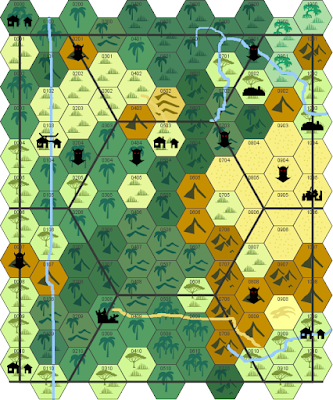
https://wiki.rpg.net/images/5/52/Sandbox2.png
In classic Dungeons & Dragons it was common to have the adventurers delving into a subterranean catacomb, mineshaft, cave, or dungeon. But one element that is equally important is the outside wilderness. Having a vast world to explore is called a "Hexcrawl" (or in more modern times, an "open world" or "sandbox"). The classic hexagon grids used for outdoor regions were a defining feature presented for player-characters to spend their days exploring and traveling from one point to the next.

Today I'm going to show you my method for creating a hexcrawl, but of course like most RPG-related things, there are nearly countless other methods as well.

Step 1 - Create Three Quests (Each With Three Objectives)

The first step, which I want to credit to Dave Chalker's 5x5 Method, is to create three quest lines. Two of these quests will be optional "side quests", with the center quest being the "main" quest. The main quest is where you'll be focusing a lot of your attention, and is often the quest in which you would entitle your module after (such as "The Dead King's Crown" or "Redeemer of the Dead King").

Each quest is broken up into three objectives; arranged in a 3x3 grid where the rows represent the quests, and the columns represent the quests' objectives (more on that later).

Quest Types

When creating quest objectives, I like to choose between a generic list that I then morph and change to suit my needs.

Offensive Objectives
  • Placement -- Secretly place an item (or person) in a place of importance
  • Espionage -- Spy on an area (or person) and report the findings
  • Destruction -- Destroy an item, person or place
  • Capture -- Capture/abduct an item (or person) of importance
  • Sabotage -- Break/trap/change a certain item, person or location
  • Infiltration -- Travel to and/or sneak in an area far away or controlled by enemies
Defensive Objectives
  • Investigate -- Uncover a hidden item, spy or secret plot
  • Obfuscate -- Hide (or disguise) an item (or person) from being found or spied upon
  • Defense -- Protect an item, person or location of importance
  • Liberation -- Set free/liberate an item, place or person of importance
  • Restoration -- Repair, restore (or heal) a certain item, location or person
  • Escape -- Escape from pursuing enemies or an area controlled by enemies
Let's make some example quests that we'll work with.

Quest 1 (Optional): Pirate's Booty -- The constable of the town is willing to hire a band of adventurers to find the source of black market goods that have been flooding the hamlet as of late. The investigation will lead the party to a small pirate's cove tucked away from the main trade routes. There they will find the pirate king Arden 'Lost Soul' Chrom, who is leading the illegal business.

Quest 2 (Main): Dead King's Crown -- The sacred crown of the late king Tipelon the Illustrious has been missing from his tomb. Recently, it has turned up for sale in the shady back-alley markets. The local bishop of the church wants a party of adventurers to brave the dangerous catacomb in an effort to return the crown to the crypt, where it belongs.

Quest 3 (Optional): Invading Marauders -- Late last night a scout came running into town with important news concerning an army marching towards the border. The lieutenant of the kingdom's garrison wants a band of adventurers to verify the information before he sends help for additional troops (in an effort to defend the borders). The party is to find the army, spy on them and perhaps even infiltrate their ranks for additional intel.

Now that we have three rough sketches, we want to organize them each into three objectives. For the first quest ("Pirate's Booty"), we can say the objectives are as follows:


Pirate's Booty
Objective 1 -- Investigate: Ask around the local thief's guild and black market for illegal wares. Follow the money trail until the pirate's cove is discussed and placed on the map.

Objective 2 -- Infiltration: Travel to the cove, then sneak into the pirate's camp to either sabotage the operation or confront (and defeat) the pirate king.

Objective 3 -- Capture/Liberation: Arrest the surviving pirates, and confiscate their stolen goods. Devise a plan to bring all of the captors, booty and ships back to town for processing. The stolen goods are given back to the people, and the pirates are thrown in prison.

Let's do the same for the two other quests.


Dead King's Crown
Objective 1 -- Defense: Travel to the catacomb with the ancient crown. Little do the adventurers know, their movements are being watched and will be ambushed by a thief organization along the way (in an attempt to steal the priceless item).

Objective 2 -- Infiltration: The adventurers must navigate the dangers within the catacomb, making their way to the burial chamber.

Objective 3 -- Escape: Upon placing the crown back on the head of the king's corpse, an ancient trap set to protect such theft is sprung (that didn't trigger when the looter's originally took the crown). The trap is designed to forever entomb the party deep within the catacomb (unless they can out-run the collapsing chambers).


Invading Marauders
Objective 1 -- Espionage: The party must seek out and find the marching army's camp. The party is tasked with reporting on certain details; such as the number of troops, siege weaponry, etc.

Objective 2 -- Infiltration/Investigation: The party was also tasked with finding out who is leading the army, and why. This requires infiltrating the ranks of the army at night and masquerading as one of the soldiers. Information is gathered about Hjora, the commander of the army.

Objective 3 -- Escape/Sabotage: The party must escape from the camp with the information, and/or sabotage the army's efforts to advance (in an attempt to slow them down).
 https://blogger.googleusercontent.com/img/b/R29vZ2xl/AVvXsEinhrRvrF12gQStMKOYKDYaZUF2YoSWhLG_ztUKgObeVPSv5Ldjbgiv-8Nmd49jt0svT9J05StEp8bvqCbNzFYxGVzZSCZZ9YbaE4ICo5FvBBKBGN1N_TFO8jVotSn6NvQPfrskoDZ8t5g/s1600/Isle+of+Fire+%2526+Cruelty+Numbered+Grid.png

Dynamic vs Static

Next we ask ourselves if we want some of the objectives to be dynamic or static. A dynamic objective will change depending on whether the task is "completed", "failed" or simply "ignored". A static quest, on the other hand, simply remains frozen in time until the party walks up to it and attempts to complete it.

Most objectives are usually static, and do not change over the course of time. However, adding a few dynamics can add variety to the adventure, and offer a sense of a living, reactionary world.

If the party successfully completes an objective, one outcome triggers. If they attempt but fail, another outcome will trigger. Lastly, if the objective is ignored (and the party pursues the second or third tier of another quest), a tertiary outcome could trigger. Outcomes can be thought of as branches in a flow chart. They can lead to all-new objectives within that quest, or branch to other objectives of other quests (see below).


For our example, we will say that if the party attempts--but fails--to follow the "pirates booty" black market money (from quest 1), then the pirates grow suspicious of the party's intentions, and go underground. The party will lose the trail. The only way for them to advance further in this quest is to later succeed at the first objective of the "dead king's crown" quest (countering the theif's ambush). If successful, the party will gain information about the pirate's cove, putting it on the map.

We can also say that if the "invading marauders" are ignored, not only will the army march across the borders, they'll begin destroying outlier settlements and farms. This creates a sense of urgency for the party, and a consequence for ignoring an obvious threat to the safety of the countryside.

Lastly, we'll say that if the party successfully completes the second objective of "pirate's booty" (infiltrates the pirate's camp), they'll learn that the pirates were actually hired by the marauding army to steal the crown of the king, in an attempt to embarrass the kingdom and ruin the morale of the settlement prior to invasion.

Cross-Connecting Quests

By tying the quests together like this, the world feels more interconnected and living. Not all quests need to be woven like this, but sometimes it can add a level of depth otherwise missing. When connecting quests in this way; you can make the connections either optional or mandatory. Mandatory connections will demand that the party pursue (and complete) one of the secondary quests (at least partially) in order to advance the main quest line. The idea is to "nest" quest objectives.

Strongholds & Maps

https://blogger.googleusercontent.com/img/b/R29vZ2xl/AVvXsEgLZ25u-6BwIcEI_d8Qu1OSVOpUtL1WvEqz3ATGVL8O1Iayc4BjdYmHOaGfCNLLxRY5JI5LfsC3yuzK_sERM_DaT8VkKHCCx-9T3K0N6UDZX5ONhRNknLejPIntV_enUQ6OMI4Nf21_PX5p/s400/WotRPHexcrawl.png

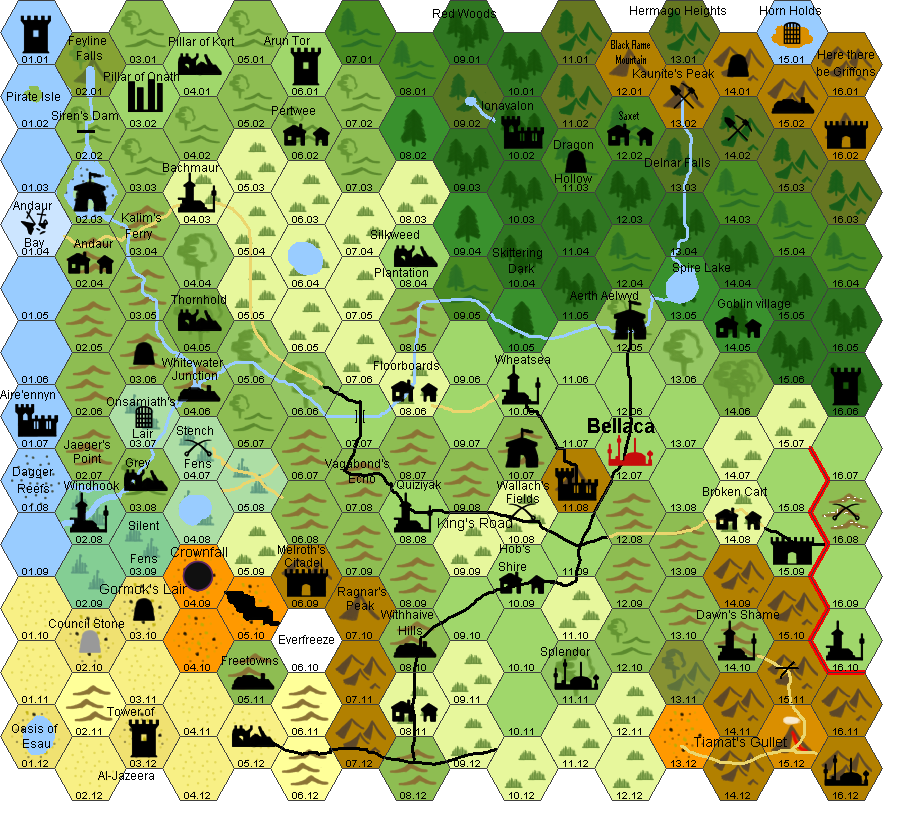
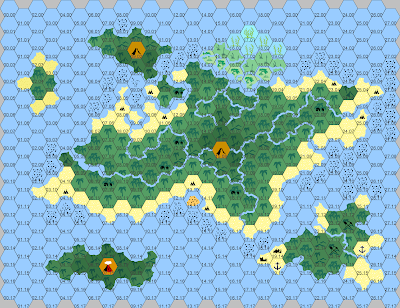
Next we need to draw out our map of the countryside. I usually like to have about five day's travel in any direction. I feel like this offers a big enough play area for the party to explore, but not feel like its super massive.

We want to place the landmarks the character's will be exploring in such a way that most corners of the map will get covered. Also consider objectives that are linked or related, and their spatial distance from each other. Try to think of the logical flow the party will travel as they pinball from one objective to another, or even from one quest to the next.

I also like to place a lot of detail on two main strongholds: one "good" settlement (usually a town, village or kingdom). This acts as a safe zone for the party to begin at, and return when they are injured or in need on fresh supplies. The other is a "bad" settlement. This is usually the principle dungeon. In our example, the dead king's catacombs would be our main dungeon.

The other quests, objectives, and landmarks can be discussed, but in far-less detail.

Micro Quests, Rumors & Ecology

As a final garnish, I like to add micro quests (in addition to the side quests already discussed). These help add a sense that the world is full of NPCs with real needs and struggles; separate from the main storyline. Micro quests are small objectives made up of one or two sentences. For example:
  • A merchant's wagon is stuck in the mud and needs help getting his wares to town.
  • A band of hunters got lost in the forest and need help navigating back to their camp.
  • A coven of seers wish to complete a pilgrimage to the top of a mountain, but cannot find their sacred cave; and are willing to bless anyone who assists them.
  • A vendor in town suspects a boy has been stealing from his tent shop; and is willing to pay a gold coin to anyone who can find the cut purse.
Rumors: A 1d10 list of rumors (some true, some false) that the party will hear along their travels from NPCs. These rumors add a nice flair to making the world feel real and living. Is it true a lich lives in a tower to the east? Is it real that the blood moon recedes the tide revealing a magical stone beneath the tidal waters? Could the marauders really be involved with the pirates and the recent disappearance of the king's crown?

Ecology: A 1d10 list of random landmarks, artifacts and natural phenomena. Again, this helps add a splash of color to the things the players may discover in their travels. These landmarks should help highlight past events, the regional climate, and cultural artifacts. For example, a statue of the king Tipelon could be at a crossroad, or a treasure map leading to the pirate's buried treasure hidden in the thief's camp, or relics of a past war between the kingdom's army and the marauders are half-buried on the borders of the countryside.

Conclusion

Though nothing I've written here is revolutionary, I hope it has helped you start with a framework for writing and creating your own living, breathing hex crawl. Thanks for reading!

Friday, May 26, 2017

Sphere of Existance

One of the things I never really thought about when first learning how to play RPGs was the different dimensions and spheres of existence in a game. After-all, they're usually not needed or even used in most adventures. However, having at least some understanding of the relationship between the different parts can help "explain" how certain extraordinary effects work.

In this post, I'd like to present my own take on other dimensions/realms/planes/spheres of existence. For mine, I'll call it the "hypersphere" of existence.

Six-Dimensional Space

In this hypersphere, there are six dimensions. The first three (which we'll call X, Y and Z) are the same as we normally think of them: forward-backward, left-right and up-down. The whole of the universe works within these dimensions similar to the modern theory of the universe. The universe itself is made up of a very large sphere with space, matter, energy etc. unfolding normally within its boundaries.

However, there are another three dimensions that exist as well. These dimensions are "hyperdimensions" that cannot normally be seen on a day-to-day basis (the same as three sides of a six-sided cube are always hidden from view). We'll call these dimensions A, B and C.


These hyperaxis are not contained inside a "bubble", like the rest of the universe. Instead, they ride along the surface of the universal boundary, like how we walk along the crust of the earth. On the surface of this sphere are four poles (explained below).

Elemental Poles

The first of these hyper-axis can be thought of running from west to east. Two poles inhabit the opposite sides of the sphere: the western pole is the coldest, and made of mostly solids and matter. This is where Earth exists; since the vacuum of space is cold and there is a lot of matter spread throughout.

As we travel east, we approach the second pole, which is the hottest and made of mostly energy and magic. In this pole, existence is only of a plasma of pure energy and mana. Only thoughts/souls/magic can exist in this hyper-energized state.

In-between these two poles exists a spectrum running from very-hot (fire) to cooler (gas/air), to cold (water/liquid) to very-cold (solid/earth).


Celestial Poles

From north to south are the celestial poles. The north pole is the high heavens, where pure divinity stands and the virtues of bravery, charitably, chastity, fairness, forgiveness, honesty, humility, mercy, prudence, temperance, tolerance and trust are incarnate. They permeate in the essence of all that is there. The wind sings fairness, the trees sway in tolerance and the sun shines honesty.

The south pole is the lower hells. Here, the heart of evil thrives and the vices of cowardice, selfishness, lust, prejudice, vengeance, deception, arrogance, cruelty, recklessness, indulgence, zealotry and suspicion are anthropomorphic. The darkness cloaks all in deception, the fires burn with vengeance and the ices forever freeze suspicion.

Near the equator is a mix of both celestial poles, where true neutrality exists. The universe here is completely indifferent to the good and evil happenings that erupt all around it. Instead, a true balance of nature is reached where only equilibrium exists.

In the Beginning...

At the very start of the universe, everything was infinitesimal. Similar to the big bang, all that was and ever will be was in a single point in space and time. As the great eruption occurred, all creation sprung forth. The universe now expands outwards, from a previous state of order to one of chaos. This expansion is very slow, taking place over trillions of years.

As matter moves from a stable state to a more unstable state, this expansion represents the passing of time. This third axis, the up-down axis (like jumping upwards towards the sky and back down to the ground), travels in a single direction: outwards. This is how time moves forward; marching forwards to an inevitable heat death for everything within it.

Most creatures cannot change their course of time travel because everything is being flung outwards. Over millennium, everything (including the earth, heaven, hell, etc.) will begin to break down into chaos. In this sense, everything exists in a slow spectrum of order-to-chaos (that takes place over time).

Alternate Dimensions & Timelines

Because space itself is ever-expanding; the possibilities of which direction matter can travel grows in possibilities to near-infinite the farther out from it's original source it travels. In the present, there is only one possibility: the one possibility unfolding in the present. But every second into the future, there grows more possibilities of how things could occur. For example, if reading this on a computer, you could spend the next second standing up, or remain sitting (but could not, say, suddenly appear at the nearest grocery store). However, given enough time, such possibilities become possible.

The same happens in the ever-expanding universe. The more the universe expands and the more you travel along the latitudes & longitudes, the more "out of phase" you become from the present. The same location (X, Y, Z) remains the same; but the viewer grows distance from their current world by traveling along the spectrum of possibilities. Ghosts and other ethereal creatures are in the same world as us (that is, the same X, Y, Z dimensions); only they're out of phase (by traveling along the A, B, C dimensions).

This phenomenon is the same as if you looked at the three dimensions of a cube, then slowly rotated the cube. One of the sides begins to shrink in perspective (but can still be partially seen).

Dimension / Time Walkers

Most creatures cannot walk in the hyper dimensions no more than we can walk vertically along a cliff (due to gravity keeping us firmly within our own dimensions). However, some extraordinary creatures (gods, demi-gods) have the ability to walk along these dimensions. Angels, demons, etc. can walk in this way, traveling from heaven/hell to the neutral equator. They can also travel from the aether-less pole (earth) to the mana-filled pole (aether).

Portals and gates simple allow an adventurer to step onto one of the hyper-dimensions and start walking on it as the new "down".


Sunday, February 19, 2017

Embarking on Dangerous Journeys


Today I want to spend some time exploring a game made by the father of role-playing games, Gary Gygax. The game is of course Dangerous Journeys.

For those of you who don't know, the history of the game is perhaps just as interesting as its mechanics.

In The Beginning...

You see, in the mid to late 1970's a man by the name of Gary Gygax helped co-create the world's first RPG, Dungeons & Dragons. He helped design the mechanics, write the rulebook, advertise and manage sales. He was the CEO of the company that published the product, TSR.

But then something interesting happened in the mid 1980s. Gary Gygax was ousted from his CEO position and forced to leave TSR forever. Here's a man who spent a decade nurturing a product that was near and dear to him, and now it was no longer his. Worse yet, the company he helped found; voted him off the board effectively making TSR a competitor. Mr. Gygax was exiled and forced to say goodbye to D&D for good.

Can you imagine the heart break he must have felt? After pouring your heart and soul into something like that, and now it belonged to someone else.

The Second Age

But, Gygax being a gamer by heart, did what any intrepid adventurer would do. He picked himself up, mended his wounds, and marched on.

To me, this is where the story of Gygax gets interesting. People tend to only focus on Gygax's first creation, Advanced Dungeons & Dragons 1st Edition (or derivatives such as Basic Dungeons & Dragons). But what kind of game would the new Gygax 2.0 create? With a new team, and nearly 15 years of experience in the industry, he had the opportunity to start completely anew.

Haunted By The Past

Except, no matter how willing Gygax was to moving on, it seemed the past was not willing to let go of him. TSR, now under new management, was determined to defend their golden goose through copyright protection. Partially because of this, Gygax had to go to great lengths to distance his new game from that of D&D. He came up with new terms (such as "Heroic Personae" instead of "Character") to insure it was a bona-fide standalone game.

Yet, alas, Gygax did not prevail. When TSR sued the company that published his new game (Dangerous Journeys), the company eventually gave in and transferred the rights to TSR, where it was promptly mothballed.

Today I want to talk about this hidden gem that was tragically killed off all too soon.

The Game


Game Basics

But now that we've talked about history, let's get into the game itself. The name of it was "Dangerous Journeys". The concept was a stark departure from that of D&D. In Dungeons & Dragons, the game focuses solely on a fantasy genre with class-based character creation (fighters, wizards, thieves, etc.). DJ, on the other hand, was supposed to be a class-less, universal system that could fit many genres (had it been allowed to continue).

Under the Dangerous Journeys umbrella was the "Mythus" fantasy roleplaying setting/game. A hybrid fantasy world, mixed with fantasy-specific mechanics.

As someone who cut their teeth on GURPS, to me all of this sounds pretty awesome! A universal system, made by Mr. Gygax? Wow! The man sure had changed since the 1970s.

How Does It Work?

Vocabulary

Well, first off, as I stated earlier; there are a lot of propriety terms. These terms are, in my opinion, un-needed in modern times, and end up detracting from the overall experience due to the confusion they cause to the reader. For example, "Personaes", or "Heroic Personaes" (HP for short) refer to what most players understand as "Characters". The fact that the acronym "HP", which commonly stands for "Hit Points" or "Health Points" is used to describe characters, is in my opinion inappropriate.

Other examples include the "Socio-Economic Class" (SEC), TRAITS, Vocation, and, oh yes, the "Knowledge/Skill" (K/S) and STEEP points. It's all very heavy jargon for a game, in my opinion. So, to spare you dear reader from a head ache, I'm going to translate these terms to more acceptable vocabulary.

Character Creation

Enough talk, let's get into creating a character! Character creation is divided into "Basic" and "Advanced" forms. Which is nice if you're a fan of "Basic Dungeons & Dragons" and "Advanced Dungeons & Dragons". Except here the two forms are in one book. Nice!

Step 1 involves determining where your character belongs in the world. More specifically, their social class. Are they a peasant? Perhaps a "freeman", or even an aristocrat. You determine this by rolling 1D6+1 (the +1 seem unnecessary. I'm sure there's a more eloquent way to have handled that, but I digress).

Make your roll and refer to the list below:


This step is somewhat important because the level you rolled (see the image above) will determine what type of class you can play later on in the creation process.

Step 2 covers the character's basic attributes, known here at "TRAITS" (with all caps, apparently). This is a percentile-based game where there are only three main stats: Mental, Physical and Spiritual. These traits are filled out by dividing 120 points between the three attributes. You decide how many points each stat has, but no stat can have less than 21 points nor more than 60 (to start).

The game goes on to state that a score of 60 is the human-maximum when it comes to abilities, whereas a 21 is a "very low average".


As with previous Gygax games, it seems Gary wanted your "Heroic Personae" (character) to be somewhat extraordinary; a cut above the crowd. For this reason, the 120 points can be equally divided into three groups of 40 (which is listed as "above average"). The advanced version of the game starts characters with twice as many points (252 pts), reiterating this "super human" focus.

Step 3 Next, we're off to choose our class...sort of. In Mythus classes are called "Vocations" and act more like a bundle of skill-sets that a character specializes in. The basic version of the game offers seven vocations, with the advanced version (found at the back of the book) offering as many as 45. The seven starting classes are: Alchemist, Astrologer, Cavalier, Mercenary/Solider, Mountebank, Thief and Wisewoman/Wiseman.

Clearly Gygax had designed an easy framework by using skill bundles that merely required the re-organization of which skills a class started with, rather than fine-tuning each "vocation" to stand out from the crowd.


The image above showcases the basic classes to choose from, along with what basic attribute they focus on, and the minimum social class you must have rolled during step 1 to be eligible to take this class. For example, a Cavalier requires your character be a "freeman, gentleman" or higher, and will focus mostly on physical skills.

Step 4 Next we'll chose our skills, known in Mythus as "Knowledge/Skill" or "K/S". Mythus makes a distinction between K/S and another term, known as "STEEP", which essentially are "skill points". Skills (e.g. lock pick, sneak, swim, etc.) are given skill points (STEEP) which represent how well your character can perform in a certain field of study. Again, a score of 20 or below is considered poor while a score of 60 or above is impressive.

As I mentioned earlier, classes in Mythus aren't necessarily fine-tuned snowflakes, each with unique characteristics. Instead, they pretty much only represent a bundle of skills. This makes sense for the type of game it is, since Gygax deliberately chose three broad abilities to define a character, and he wanted the game to be both percentile-based and universal.

The "Skill List"
So how do skills work? Well, first let's take a look at the alchemist class as an example.


What we find is that the class has a list of skills (as mentioned before), along with what basic attribute (physical, mental or spiritual) the skills are based off. In the far-right column we also see the starting skill points (STEEP) that the character gets for each skill. These skill points are added to one-half (1/2) of the character's basic attribute. For example, an alchemist with a mental score of 30 would add one-half of that (15) to their mathematics score of 20 (for a total of 35).

Why one-half of the basic score? I have no clue. I suppose Gygax didn't want the numbers to climb to 100 too fast. However, I feel like the same goal could be achieved by simply reducing the number of starting skill points; or starting with less points for the basic attributes.

Additionally, there are three "universal" skills all players get: native tongue, perception and riding.


We're not done with skills just yet. Gygax decided to allow the players to customize their character further by choosing "bonus skills". The way bonus skills work depends on which of your basic attributes (physical, mental, spiritual) has the highest score, which has the lowest and which is in the middle. You choose a number of bonus skills equal to 3, 2 or 1 (for your highest, second-highest and lowest basic attribute, respectively). For example, if your character's spiritual score was the highest of the three, you choose three bonus spiritual skills (e.g. magnetism, metaphysics and street-wise). You'd do the same for your two other basic attributes (with one progressively less skill for each).

You might be asking how many skill points each of these bonus skills starts with, and the answer is 10 points.

Step 5 which is, oddly enough, called "Step 6" in the rulebook (it seems step 5 is missing), involves determining the starting money for your PC. However, it's not a simple matter of rolling 3D6 to determine how many coins are in your pocket. In Mythus, you have "Net Worth", "Bank Accounts", "Cash on Hand" and "Disposable Monthly Income". The currency is called the "Base Unit Coin (BUC)". How's that for generic?

To start, you determine your PC's social economic class (found in step 1) then roll a certain number of dice for each money category (as shown in the table below) based off their social class level:


Step 6 The final step involves finding some miscellaneous information about your character. Specifically, their physical attractiveness.


Roll a 1D20 and pray you roll above a 7.

For the basic version of the game, that concludes the character creation process. The rest of the book goes into "performing actions", "heka" (which is their proprietary name for magic/mana), "combat", "leveling up", "how to play your character" (and example play sessions), the advanced version of the game, "game master rules", two sample adventures and "magic items" (along with an appendix). All of these topics I'll have to save for another post.

In Conclusion

Deep down, the mechanics of this game aren't bad. If you're into percentile-based RPGs, there's a good balance between the luck-of-the-draw and customizing your character the way you want.

The Good The game had massive potential, on paper. It was a universal system, it used D100 percentile rolls, and the basic version was intentionally left generic. This allowed players (and GMs) to tailor the setting to almost any genre (though the game was flavored towards fantasy). A "wiseman" could become a "jedi" or a "cavalier" could become a Captain America of sorts.

I also liked the tie-ins between a character's starting social status and the options they had available later in the creation process. Once the system is understood, the mechanics are fairly easy to follow and transparent in intention.

The Bad At times the game feels too generic. The BUC is a good example of where one-size-fits-all doesn't always "feel" right in certain settings. Species apparently aren't an option to choose between during character creation. There also wasn't enough differentiation between the classes (but this is more of a gripe I have towards skill-based systems as a whole).

The skills also felt a little confusing (e.g. "Phaeree Folk & Culture", "Apotropaism"). They also came off as a tad bit random since some seemed far more useful in a day-to-day play session than others (e.g. "combat, missile" will always be better than "agriculture").

Instead, I think Gygax should have let players make up their own skills, and assign them to the most logical basic attributes with a generic number of starting skill points.

The Ugly Obviously the TSR lawsuit sunk this ship; but even if TSR allowed the game to publish and thrive, there were still some major rough edges that needed grinding down. To start, the cryptic nomenclature is almost laughable. Referring to things as "K/S", "STEEP", "Heroic Persona" and "SEC" isn't my idea of a fun Friday night. While I appreciate the great lengths Gygax went to to avoid a lawsuit (which ultimately happened anyway), the vocabulary needs some major cleaning up. If a "retroclone" of this game ever gets made, it's the first thing that has to go. Use normal, industry standard terms that everyone knows and loves.


Secondly, the wall of text. Each page is jammed packed with small-sized font that talks about every facet of every mechanic (and doesn't always do a great job of it, either). Many concepts and ideas could be explained in far-less verbage, and allow for more white space.

Monday, September 19, 2016

How to Use New Rules to Capture the Classic Feel


Today's post is a partial response to the above video made by "Black Belt Games". If you haven't seen it, I encourage you to watch it and the two other parts to the series. It's a discussion about the Advanced Dungeons & Dragons 1E classic feel, and how that contrasts to many modern RPGs (including modern D&D).


Classic Style Dungeon Crawling

In the video there is talk about the methodologies used to negotiate a dungeon back in the 1980s. Specifically, how players often had to rely upon their own wits, common sense and attention to detail (to the GM's descriptions of both room, scenarios and circumstances) to avoid traps, ambushes, solve puzzles and otherwise get into a dungeon, loot it of treasure, and survive on the way out.

This, as the video says, is a very different approached compared to the emphasis, encouragements and negligence of modern tabletop gaming. Today's players often have what has been called "Heads Down Syndrome"; which is to say that whenever a problem is presented to a band of adventurers, every player looks down at their character sheet to figure out which skill, feat, spell, etc. they can evoke to solve the problem. The entire affair of navigating a labyrinthine dungeon of horrors has been reduced to a simple act of "hunt and peck" for the best superpower that suits the problem. This is akin to having a toolbox full of tools, and your three hour game session boils down to being presented different scenarios and your only job is to find the right tool.


In classic gaming, and that of the Old School Renaissance (OSR) community, YOU--the player--had to out-think the problems you were presented. The tools you had at your disposal were whatever your character was physically capable of doing, as well as whatever equipment your character was carrying on their back.

Characters were no super heroes out of the gate. They were mortal men and women who were very squishy and often times met an untimely demise (sometimes early into the adventure). This in turn encouraged players to handle their characters more cautiously. No smashing down doors without first considering the noise it'll create in a cramped dungeon; and whose ears may be alerted to your presence. Traps were a constant fear, and the seemingly-now-extinct tricks would play with player's minds.

If you've ever played the game "Dungeon Quest", you'll understand the sentiment I'm trying to convey. It's a parallel solitaire boardgame of players-versus-the-game style where you are an adventurer trying to get to the center of a dungeon, rob a sleeping dragon of its riches, and get back out before sundown. The challenge is hinted at when the rulebook states there's only about a 20% survival rate. What other boardgame have you played has proudly stated such a steep difficulty? It immediately sets a mood "survivalism" and adds tension and excitement to the play session.

Skills Systems

In OD&D, BD&D and AD&D 1E there were no such things as "skills". No skill checks, no +1 to falconry or anything like that. The logic was that if your character attempted to do something extraordinary, they would simply roll 1d20 and hope they rolled under their score ("Roll Under for Achievement"--RUNA). The six attributes (strength, intelligence, dexterity, constitution, charisma and wisdom) were broad enough and generic enough that they could (theoretically) cover 80%+ of the situations you had to roll for. I've always found these six attributes genius, really. They were perfectly balance; not too generic but not too limiting.

Yet in 2E and on we begin to see the introduction of skills. Even Rules Cyclopedia introduced optional rules for a skill system. The idea was that characters could have a base score for their six attributes, but then excel in certain fields of study, or perform poorly in other fields, in some cases. To me, the introduction of skills was genius. It allowed players to further flesh out and express their characters. It allowed characters to be more individual.


Yet, as often happens, sometimes there is too much of a good thing. As Wizards of the Coast bought the Dungeons & Dragons intellectual property from TSR, we then saw tons and tons of skills, and even more bonuses, feats and so forth. I call this transition the "death of a thousand +1's". The ability to mix and match various bonuses, spells, feats, skills and so forth caused huge swings in balance. The traditionally physically weak wizard could suddenly negate their weakness with feats, and amplify their spells to ridiculous heights; which in turn caused an arms-race between the classes, in an attempt to keep up.

So it should be no surprise that in today's age many people of the OSR community reject skills, almost on principle, because of what it has lead to. But what if there was a better way? A compromise?

Let's start by throwing out the skill tables/lists. Every RPG tries to come up with their own unique list of skills that the designer thinks the players will need in their adventures; depending on the genre of the game. However, we've all been ignoring the gorilla in the room: if skills are based off the type of action, then there are literally tens of thousands (if not unlimited) potential skills a player character could engage in. Trying to cover every conceivable action is ignoring the genius that Gygax gave us: the generic "six attributes" cover most of what we need. So, we need to adopt a "one size fits all" model, rather than a "1,001 skills" model.


Let's imagine that every player started with a number of "skill points" equal to their intelligence. There are no defined skills in the rulebook. Instead, players are encouraged to "make up" their own skills based off what they want their character to know, instead of what the game designer thinks they want them to know. For example, if I was making a burglar and I have 10 skill points to allocate, I could choose to place them like so:
  • Lock Pick: +2
  • Hide Motive: +5
  • Climb: +3
In my mind, I want my character to pick out victims he'll steal from, then talk with them under the guise of becoming their friend. In truth he'd be fishing for information to determine if they're wealthy, and if so, where they live and any security measures he should be aware of before robbing their house.

Because this example skill system is amorphous, I was able to tailor my character exactly how I wanted, rather than being pigeon-holed into a preset. That's not to say that you can't provide example skills for players who enjoy the "pick and go" method to character creation.

Professions

One mantra the OSR community likes to parade is more narrative freedom and emphasis on GM fiat and player character expression. The idea being that there should be more immersion within the game; and less about preset superpowers or getting lost in the complex rules. This sometimes is expressed as a "roll-playing versus role-playing" argument.

One aspect I'd like to see expanded is a character's background; specifically that of their profession. Where did your character come from, and what trade did they take up prior to adventuring? What skills did their trade teach them? Why did they take up that trade? Answering these questions is a great way to develop a personality for your character and better understand the hardships (and growth opportunities) they experienced in their past.


Many modern RPGs treat professions similar to that of skills. Game designers try to come up with a list of professions they think the players will want to play, throw handfuls of +1 modifiers at the previously mentioned skill list/table in a way that they think best suits that profession, then call it a day. For example, a game designer might determine that a "ranger" profession pivots off the idea of having an animal familiar, and so states that all rangers get a +2 to animal handling.

The problem will all of this is the same as that of skills: there are literally thousands of professions out there, and the multitude of skillsets required to operate effectively within each of those professions can differ dramatically. Game designers are faced with a fork in the road:
  • Create a massive compendium of 1,001 professions that covers as much as humanly possible
  • Create a paired down table that covers a few core professions that is subject to the designer's own biases/preferences
  • Ignore the whole problem and don't have support professions or hand wave it away
But what if there was another way? Something akin to the skills system laid out above. What if we had the audacity to let the players "make up" their own professions? Would the world end? No, I don't think so. So long as we say that players can choose any profession/background for their players but every part is subject to the GM's approval, I think we'll be fine.

This "virtual profession" system opens the flood gates to countless job titles that we don't typically see in RPGs. Instead of being a "fighter", suddenly you could be a "baker" or a "fletcher" or "artisan". The real question is, how would this self-proclaimed profession affect the in-game mechanics? For that, we turn to our next point.

Advantage/Disadvantage System

One of the best things that came out of fifth edition Dungeons & Dragons, in my opinion, was the "advantage/disadvantage" system. The premise is so simple, yet can be used in a wide range of areas. If your character has advantage in something, you can roll twice and take the better roll. Disadvantage was simply the opposite: roll twice and take the worse of the two rolls. Genius.


We can take this simple, yet "modern" system and apply it to our professions and skills system. Here's how (this may come off as a bit controversial and bold):

Rule 1: Anytime you would perform a skill test, you must perform it with disadvantage.

I don't know about you, but to me that's a pretty sweeping rule. It sounds kinda dumb, too, at first glance. Every single time I want to pick a lock, climb a cliff or bargain over the price of an item, my character has disadvantage? Why? Here's why.

If your character was a warrior for many years, it is reasonable to assume that they are good at all things warrior-related. They're good with a sword, battlefield tactics, command structure and so on. But if a character attempted to perform an action they've never done in their life (e.g. the warrior attempts to dance), they're naturally going to suck at it. But if it's an action they've done many times professionally, or because they're naturally skilled in it, they wouldn't suck (aka wouldn't have disadvantage). So, performing all actions with disadvantage is another way of saying "As beginners, we all suck the first time." so all actions we perform start with disadvantage. To complete this train of thought, we need a second rule:

Rule 2: If your character attempts to perform an action that would fall within the responsibilities of their profession, or they have one or more positive modifiers (e.g. "+1") in that skill, they can perform that skill test as normal (without disadvantage). 

Let's imagine that warrior, who is used to forced-marches, battling foes on the battlefield, and sleeping in military encampments, suddenly finds himself deep in a dungeon and wanting to climb down a sheer cliff face. The GM could make a call that "rock climbing" is not in the job description of a warrior, nor did the player choose to put any of their skill points into such a skill, therefore if they do choose to climb down the cliff they will do so with disadvantage.


At this point I want to take a moment and discuss what the implications are for such a set of rules. What would you, the player in charge of this warrior, think knowing their life hangs on a climb test with disadvantage? How would you react? My guess is your reaction falls somewhere within one of these possibilities:

  • Discouragement: You think "gee, on second thought climbing down this cliff looks dangerous and I don't really know anything about rock climbing. I better not."
  • Teamwork: You think "gee, on second thought climbing down this cliff looks dangerous and I don't really know anything about rock climbing. I better let the rogue do it since it is actually something he does professionally."
  • Inspiration: You think "gee, on second thought climbing down this cliff looks dangerous and I don't really know anything about rock climbing. I better get out some rope."
Of course it is possible you might think "this sucks" and attempt to flip the gaming table over in a fit of rage, but I hope cooler heads prevail. Anyway, I want to talk about each of these points individually.

In the first reaction (discouragement) we have a dangerous situation that forces the player to play more cautiously, and to second guess their decisions. This is the exact style of play the above video was talking about when they described the "feel" of AD&D 1E. We want things to be hard. We want things to be deadly. We want the characters to fear for their lives and stay close to their strong points.

In the second reaction (teamwork) we have what I call a "soft class limit", which is different than a "hard class limit". To better explain what I mean, I'll tell you of something that happened to my fighter character last night, during my weekly AD&D 1E session:

[My fighter and his allies were climbing the stairs leading to the top of a pyramid.]
Me: "As I climb the stairs on the right-side, I want to look carefully at each ledge to see if I notice any foot prints or other sign of recently activity."
GM: "Are you a ranger?"
Me: "No..."
GM: "You see nothing."
I couldn't help but chuckle when the GM said this. However, my initial reaction was both a positive and negative one. Negative because I felt like it was unfair for my character to insta-fail at attempting a task simply because I was not a ranger. This is what I call a "hard limit" to a class. Because I wasn't a ranger, I had no chance of succeeding at tracking.

However, I also had a positive reaction: I was obviously attempting to do something outside my expertise, and the GM was reminding me to color within the lines, or, put another way, "play your class/role".

The balance between these two reaction is to have limits, yes, but not make them so glaringly black and white. Make the limits "soft". We can encourage teamwork between players by giving everyone a role to play. If you're a fighter, you knock heads. A thief "knows things". A magic user casts magic. But characters should still be able to attempt any "skill", it's just that if they try to do something that isn't within their profession, they get disadvantage. Success is still possible, just far less likely.

The last reaction (inspiration) is all about using an obstacle or problem to foster creativity. Specifically, through dungoneering equipment.

 Equipment

In the video, the narrator mentioned how in old-school RPGs, players would spend considerable time carefully picking out the necessary equipment needed to travel overland, enter a dangerous dungeon, cave, catacomb or castle, loot it of its treasure and return home safely. In a way, equipment was the original "skill system". The idea being that equipment was used to augment or enhance character capabilities. In modern RPGs players choose a bunch of skills and gloss over equipment. But back in the day, however, skills didn't exist and players picked spent time choosing equipment.


Equipment, and resource management, should play an important role in any adventure. But in today's age it's hard to convince players of the importance of equipment because it's often difficult to quantify its importance. We can say that equipment does one or more of the following:

  • Opportunity: Some actions, without the necessary equipment, simply cannot be done. For example, one cannot pick a lock without a lock pick kit (or home-made equivalent). Therefore, much equipment simply affords characters the opportunity to do something otherwise impossible.
  • Value: Of course equipment has a price, or a value associated with it. Treasure is a great example where it has no utility function; it's simply there to be sold for money.
  • Enhancement: Some actions can be performed without equipment, but by using equipment, it greatly increases your convenience or chances for success. A rope used while climbing down a sheer cliff is there to help you, though you could attempt to do it without such an aid.
The first two points go without saying. A key unlocks a door, a torch lights a darkened passage, and a beautiful painting sells for big bucks. But the last point (enhancement) can be harder to pin down. For this, we need a third and final rule:

Rule 3: If a character attempts an action that can be performed without equipment, but uses equipment to aid them, they may perform that action normally (without disadvantage).


With this rule, we can provide a universal value to all equipment. Characters are encouraged to buy and use various gear because it will offset the default disadvantage most everyone has to suffer when performing an action outside of their comfort zone. Players will be less likely to skip through the equipment acquisition step of character creation. They can compare their character's strengths to that of the opportunities and enhancements provided by their accessories.

Conclusion

To tap into the spirit of classic gaming, we don't need to be super-specific like modern RPGs are today. We can have broad-reaching professions that provide a fast-and-simple advantage system. We can also use the popular skill modifiers that are in literally every RPG made today, but tone down the complexity and tailor it as an expression of our character's background and personality. Lastly, we can bring back the important of expedition equipment by giving players a small treat for using it.

Saturday, September 17, 2016

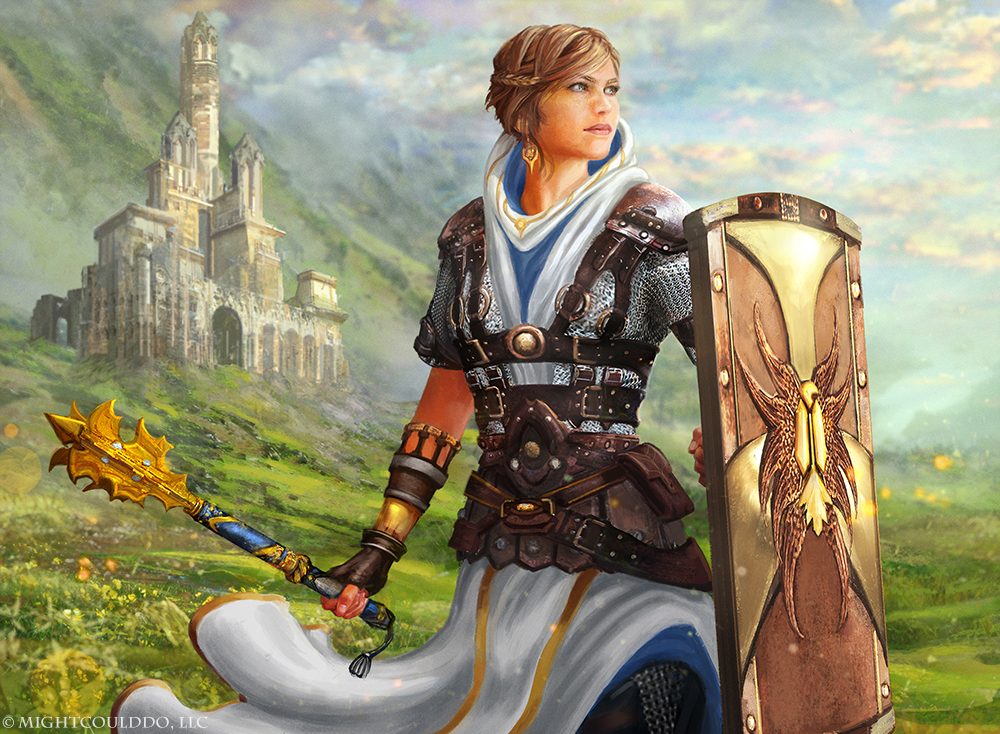
Making a Better Cleric


I'm not sure if anyone caught this, but I figured I'd share this little nugget about clerics in the Basic D&D booklet (red cover).
"...Clerics do not receive any spells until they reach 2nd level (and have proven their devotion to their god or goddess)." -B9
Interesting justification in parenthesis there. Clerics have to first go through some trial or test of faith before their deity endows them with a glimmer of their divine powers. We also see another idea on the same page:
"...Clerics are forbidden by their religious codes from using edged weapons, such as swords and arrows." -B9
I have little doubt that both quotes are simply excuses to justify mechanics set up in an effort to "balance" each class. After all, a fighter with magic powers is automatically more awesome than just a fighter, so the designers had to add artificial restrictions. But that doesn't mean we can't take something from this sentiment.

The big takeaway here is that:
  1. Clerics must prove their devotion to their deity before recieving bonuses (or perhaps suffering a penalty)
  2. Clerics are forbidden from certain actions
Next up we check out "Turn", or as it'd later be called in Rules Cyclopedia (RC) "Turning Undead".
"Clerics are very helpful when undead monsters (such as skeletons, zombies and ghouls) are encountered. When a cleric encounters an undead monster, the cleric may attempt to 'Turn' (scare) the monster instead of fighting it. If a cleric Turns an undead monster, the monster will not touch the cleric and will flee from the area if it can." -B9
Interestingly, it goes on to say "If a cleric is successful at Turning some undead monsters, the player must roll 2d6 to find how many hit dice of undead monsters are Turned." which is different than what is found in RC, which states "...the Dungeon Master (not the player) will roll 2d6 to determine the number of Hit Dice of undead monsters that turn away."

Breaking it all Down

The Cleric is a complicated class. It's a hybrid of sorts, really. It can fight similar to a fighter, but can cast magic similar to a Magic-User, though it has its own magic and has a special ability called "Turn" (or "Turning Undead" if you're reading RC).

The benefit we have is we can start with the red cover BD&D booklet and jump into the future by reading AD&D 2nd edition, Rules Cyclopedia, 3.x, 4E and 5E. We can see how the cleric began, conceptually, and how it changed and matured over time. In my opinion, it's more important we understand the "spirit" of the cleric and the intended flavor of the designers, more than the individual rules and score numbers (although you know I'm going to look at them anyway, so we might as well get started).

Exigences

In my own game, Open Adventure (OA), each Archetype has a set of "exigences", which is a fancy way of saying "requirements". These actions must be performed on a daily occurrence, lest the individual powers of an archetype begin to wane. This is the same sentiment that we see with the first quote about clerics ("proving ones devotion"), but this is also found with Magic Users (in BD&D) being required to be well-rested and spend 1 hour to memorize spells. The idea in my game is that a "disciple" (the OA equivalent of a cleric) must devote 1 hour to prayer and devotion per day.


Additionally, disciples must follow three "rites" (required rituals) and abstain from three "ascetics" (forbiddings). The specifics of the rites and ascetics are left to the Game Host, and are modeled after the individual focus, alignment and wishes of the specific deity that the cleric obeys. Lastly, because in OA alignment can change based off player character actions (or the virtues & vices they obtain), disciples must remain of the same alignment as their deity. Such rules allow for a more open, free-form alternative to the idea of clerics having religious codes that suit the desires of their deity, rather than one single rigid path (e.g. clerics are forbade from using edged weapons [as a side note, if a cleric worshiped an evil deity, wouldn't they WANT you to use edged weapons to kill your enemies faster?]).

If a disciple were to lapse in any of the above requirements, the penalty they suffer is total revocation of their clerical magic. In other words, if they don't keep their patron deity happy, their deity cuts them off. But don't worry, they can get their mystical powers back after 6 hours of devotion to their deity and apology for their "sinful" ways.

Alignments

In BD&D they had the option for good clerics to be a bit naughty. They could be bad (or evil in a way) by casting a clerical spell, but in reverse. Instead of healing someone, you could cause them injury, for example. This was a great play on the polarity of good and evil (or law and chaos, as it was called back then). It hinted to the possibility of there being evil, or dark, clerics; which in turn gives raise to professions such as "necromancers" and "vodoo priests". But, in my opinion, this "alternative cleric" was never fleshed out enough.

If we fast forward into the future of D&D, especially 3.x and beyond, we see this concept comes to fruition. There are rules for good-aligned and evil-aligned clerics, and how they can channel positive and negative energy. In my opinion, basic versions of these rules should be included in BD&D since they were essentially missing from the start.

So, we have full support for good and evil clerics. But what about neutral clerics? If you're thinking to yourself "there's no such thing", you'd be wrong. In Rules Cyclopedia, in fact, it talks about how Druids are a prestige class, of sorts, derived from clerics. Since Druids are always neutral, we essentially have support (or at least tolerance) for the idea of neutrality existing within the ranks of the cleric class.


However, the way druids are handled in RC has never seemed right to me. Why must we wait until level 9 to become a druid? Even if we did, why would a cleric remain ardent to one alignment for 8 levels then decide to walk away from the cosmic battle between good and evil (not to mention the cities of men) to live among forest animals?

Instead, I propose the druid become its own class that can be pursued at level 1, and treated as a neutral cleric that devotes itself to the cosmic force(s) of the material plane. This would explain why nature and the universe are so sacred to a druid/neutral cleric, with none of the "ex pat" mid life crises.

Exorcism

The last topic we need to tackle are the special powers that these disciple/cleric characters posses. Whatever they end up being, we can conclude that they A). are either only given to a cleric if they are "ardent" in their faith and/or can be revoked if the cleric isn't walking the path right, and B). should fit the theme and focus of the cleric's alignment. That means support for good deeds as well as neutral and evil ones.


The common thread with all clerics throughout the history of D&D has been the ability to repel undead. First, the term "Turn" or "Turning Undead" should be changed. It's a confusing term that has no intrinsic meaning (that I'm aware of) outside of D&D, and must first be explained to be understood. Rather, the term "exorcism", which is a real term, is far better suited for the job.

Terminology aside, a purview of the 3.5 rules show us that there is a far more refined approach to clerical exorcism:
  • Good-aligned clerics can attempt to destroy or rout (force to retreat) undead creatures
  • Evil-aligned clerics can attempt to command or rebuke (force to cower) undead creatures
  • Neutral-aligned clerics can mix and match between the two options
As much as I love OSR and Basic D&D, I have to say that these "new" rules are far more in spirit with what the "old" rules were trying to do. They fully support all the alignments by offering fun alternatives to evil clerics (commanding the undead rather than destroying them).

While we're discussing "turning" undead, let's talk about that "turning undead" table.


This bad boy has got to go. From a game design perspective, it's never a good idea to have such an innate common ability require such a large and verbose table. Especially when it can be condensed down into a few simple rule statements.

To start, the whole premise uses a 2d6 system. Since it's based on the idea of routing, or invoking fear and panic, in undead, we can replace this monstrosity with another system already in place: the morale system. The morale system exists to gauge a creature's willpower and whether that creature is fearful during combat (or other situations) and chooses to flee. Sound familiar? Yup, the morale system also uses a 2d6 mechanic. The two systems are practically identical.

All that has to be done is make a rule that says a cleric can force an undead to make a morale test when they attempt to exorcise them. The 2d6 roll adds the level of the cleric. If the roll is over the creature's morale number, the monster is affected. The next rule we need is to say that if the cleric's level is 3+ levels higher than that of the monster's hit dice, they are automatically destroyed (or commanded, if evil) instead of routed or rebuked. If a cleric is level 10 or above, they can affect 3d6 creatures (instead of 2d6). At level 25 they can affect 4d6 creatures, instead. Voila!

Miscellaneous

Okay I lied, exorcism isn't the last topic. I want to look at some of the differences of how clerics are handled in different versions.

Holy Symbols
To start let's talk about holy symbols. In BD&D and RC there is no rule about holy symbols being needed to exorcise undead. In fact, RC (page 14) reads "The power to turn undead is inherent in the cleric; he does not need the symbol of his faith or any other device to do it, unless the DM declares otherwise."

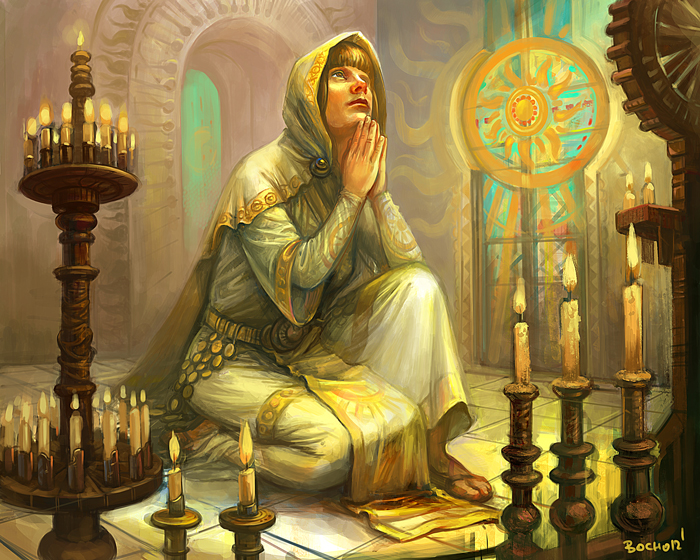
To me, I find this ruling a bit odd. We're all used to seeing priests and other holy men pulling out their holy symbol and using it as a ward to keep evil or undead at bay, often times in tandem with holy words. In fact, Wikipedia has this to say about exorcism:

Exorcism (from Greek ἐξορκισμός, exorkismos – binding by oath) is the religious or spiritual practice of purportedly evicting demons or other spiritual entities from a person or an area they are believed to have possessed. Depending on the spiritual beliefs of the exorcist, this may be done by causing the entity to swear an oath, performing an elaborate ritual, or simply by commanding it to depart in the name of a higher power.

Followed by this photo:


Looks like that cleric has a holy symbol in his hand, and based off the description there's some form of verbal component involved.

I feel like disallowing a holy symbol goes against the grander spirit of what a cleric is and does. To me, a cleric has always been a conduit of their deity's powers. The cleric themselves only have mystical spells because they are so faithful to their god. In turn, their deity empowers them so they can complete their quest/conquest/mission in life. Their holy symbol, in turn, is a focal point of those powers.

Now, some readers might feel compelled to point out that all of this talk about exorcism has to do with evil creatures (aka fiends) and not undead. That's a good point, but I still believe that for consistency sake, a holy symbol should be present. Looking into the future (at 3.x D&D) we see that exact ruling being enacted, whereas holy symbols become a requirement to "turn" undead.

Affected Creatures
Another interesting difference between "old school" D&D and "new school" is how they handled which creatures are routed and which are not (since you might roll X, where X is less-than the total hit dice of undead creatures within range at the time of the exorcism). In BD&D it states that the lowest level creatures (such as skeletons) are routed first, then the extra points are distributed to higher leveled creatures. Presumably this is to emulate the weaker-minded creatures being more vulnerable to the effects of exorcism.

In newer versions of D&D, however, it says that the creatures physically closest to the cleric are turned first. This, I assume, is to emulate a "blast" effect with the exorcism; as if it is exploding outwards from the cleric's body or holy symbol.

Personally, I think both can be used, in combination. The rules state that after a cleric exorcises undead, they roll 2d6 to determine how many levels/hit dice worth of undead are routed. A simple ruling would be to say start with the lowest leveled ones. If there is still a tie, or you need to know which one of that group to begin with, start with those closest to the cleric. If there's still a tie, the cleric gets to choose.

Conclusion

Clerics can be a lot of fun, but I don't think there's a perfect version of D&D out there. Instead, it behooves us to take the best parts of each version and combine them to paint a picture of what we think the designers had in mind, as well as keep the effects grounded in historical fact (based on tradition and mythology).

Wednesday, September 7, 2016

The Science of Badassery

The more I play RPGs, and the more I design them, the more I find myself asking the same question over and over:

"What truly is a role-playing game?"
I don't think I'll ever have one, ubiquitous, empyrean answer because I don't believe that there is just one answer. In this week's post I want to delve into the meaning behind RPGs, specifically how it relates to character creation, the science behind making a good character, and hopefully throw out a few ideas to help make our characters more badass.

No, not that kind of badass!


Exhibit A

To begin, let's do a thought experiment. I want you to look at the pictures below, which are a sample of the different unit types from the video game Starcraft 2.


For many readers, I imagine that this is the type or style of character you are dreaming of when you begin your character creation process. Your adventurer is decked out in gear, looking like they've fought in a few warzones, and are relatively skilled or otherwise intelligent in their trade. If this is the intended result, then we must ask ourselves two questions:
  1. Do the current RPGs of today actually produce a character of our desired caliber?
  2. If not, what must we do to create such a character in our collective minds?
For the first question, I would argue that no, most modern (and old-school) games do not in fact give us characters like the above examples, for two primary reasons. Let's discuss.

1. Stories, not Numbers, are Badass

If we take Dungeons & Dragons as an example, especially the older varieties, what is the first step we're asked to perform (as players creating a new character)? Roll dice. That's right, roll 3d6 six different times to formulate a bunch of numbers for an array of basic "attributes".

Does that sound badass to you? Does a stat of 15 sound like something memorable, or make you want to make a movie out of, or hang a poster of on your wall? Probably not. Because numbers are just that: factual data that requires us to tap into a whole different region of our brain from that of the more emotional side that rejoices in badassery.


This is where we have to define our definition of role-playing games, because I believe that at their core an RPG is an interactive story which requires two parts; interaction (which is governed by rules, mechanics and dice) but also story. We need equal parts game and equal parts role-playing. If we ignore role-playing, or the story/setting of an adventure for the rules of a game, we might as well play a board or card game instead. If we ignore character personality, background, talents, relationships, etc. for attribute scores; we're doing ourselves a disservice. Therefore, factors, such as the numerical value of a stat, should be kept in the background--especially during character creation--when we're trying to define who, truly, our character is going to be.

If we really want to rally behind the adventurer we're creating, we need to begin by telling the story of him or her. Who are they? Where did they come from? Was their family rich or poor? What profession did they take up? What motivates them? There seems to be 1,001 different facets to cover; which brings us to the second reason why modern RPGs don't create badass characters for us:

2. We, the Players, Suck at Being Badass

Rather, we're not very good at coming up with badass ideas for our characters. It's not that surprising, really. Most of us, especially the average tabletop player of today, are not full-time dedicated fiction writers. We're bakers, accountants, tradesmen, researchers and so on. Creating an in-depth, well thought out character is difficult! Especially if you're trying to design something "cool" on the fly with little to no inspiration to draw from.

This is why it's so important that game designers encourage players to tap into their creative side of thinking when designing a new adventurer. We can do this by offering tons and tons of inspiration. Ask the big questions about their characters. Get the players thinking of not only who their character is now, but who were they in the past, and how did they get to where they are today? You see, there's a treasure trove of information to build on in a character's background.

Character Creation Redefined

Sadly, most RPGs treat backgrounds as a footnote. It's one of the last steps that we pay lip service to by saying something to the effect of "Create an awesome background! You can make it be annnyytthiinngg!" and end there. Gee, thanks game designer, you really inspired my inner badass (sarcasm)!

Let's re-build character creation from the ground up. I believe Traveller had it right, in that the focus should be on the character's past stories, and how those stories have created the character they are now. Don't just assign scores, give each of those scores a story. How did your buff warrior become so strong? Why did they take up warriorship? What campfire tales do they have to share?

The more answers we have to the questions about who our character is, the more of a badass they become. Suddenly your elf is not just an elf, they're an elf who's city was lost to a great flood, was forced to endure hardships until she settled in a distant city of mankind. She's naturally proficient in magic not "just because", but because she was trained by her grandfather (before the flood) then later was a protege to a minotarian mage before devoting herself to a deity and converting to become a templar for the local order. 

"Not only do I look badass, I am badass!"


Breaking it Down

There is an unspoken agreement that the majority of adventurers begin their adventuring career at a young (but not too-young) age. Young of course is relative, since various demihumans live to be quite old in human standards (e.g. hundreds of years in age). But I'd say that most adventurers become young adults at the first 1/5 of their lifespan. If 80 years is the lifespan of a human, this is about the age of 16. The years before this are the adolescent or childhood years, and the second 20% of their lifespan (17 through 32 years for humans) is when they become true adults and take on a trade, profession, class or job. In otherwords, they become experts in a subject and excel at their career.

Yet all of these formative years are glossed over, or worse yet, completely ignored, when it comes to character creation. Most games are only interested in where a character is now, after all that growing, learning, exploring and career-building.

But doesn't all of that seem important? Take Batman for example. In his youth, his parents were murdered during a mugging and Bruce Wayne had to face his phobia of bats. This, in turn, guided his motives in life to end the crime spree in Gotham. In "the Dark Knight Rises", half of the movie is dedicated to this story. We see Bruce Wayne's ninja training, his going rogue from his master teacher, the formation of the batcave, batmobile and other technology, as well as his early career as a crime fighter. All of this is compelling, entertaining and establishes Batman as--you guessed it--a badass.

Example Badass

Let's say we want to make a special operations soldier. We'll use the Starcraft portrait on the top row, third from the left (a "terrain ghost" for those who play the game). Well, what does that look like? Again, I don't care about the numbers. What makes our character so good at what they do? We could say that he grew up on a border town, not far from the front lines of the humans versus the evil aliens. He joined the local law enforcement, and, for a number of years, worked as a SWAT-type marksman (let's give him a high WIS to reflect this), but then changed gears and was the chief instructor of a select cadre that taught self defense and martial arts to other enforcers. From there, he was drafted into the war and was a soldier for a numbers of years, serving as a sniper. Finally, he joined the elite "Raiders" squad that is tasked with sabotage and assault behind enemy lines.

Quite the background, don't you think? I haven't even used a single number or ability score, either, and we can already tell that this is a character that shouldn't be messed with, and probably excels with firearms and other ranged weaponry.

Conclusion

I hope future game designers will not only stop ignoring character backgrounds, but embrace them. I mentioned earlier that players are not good with coming up with compelling character backgrounds; that we all need a little help with our writing. As game designers, it's up to us to help inspire players. Offer them options to choose from, or plot ideas. Have the players answer some key questions regarding their character's past, personality and motivations.

Take a look at Ash's Guide to backgrounds and personalities for player characters. I'm sure you'll find it in-depth with a lot of ideas to think about. By the time you've filled out all the information listed there, you'll have a pretty deep character, which is turn allows you to roleplay him or her better, and affords your friends to play off your character badassery.