Monday, August 21, 2017

How to Use Strategy & Tactics to Improve Your Game & Life


In this post I want to start a series discussing strategy & tactics; both general and specific--as well as old and new. I'll discuss how strategy can be applied to nearly any game you play; as well as how you can use some of the lessons here in your own life for personal success.

The concepts outlined here are learned from years of me playing strategy games like chess, real-time strategies video games; as well as my own personal study in the subjects. However, I'm by no means a de-facto authority or expert in this field; and will leave more advanced topics to the true masters.

General Strategy

To start, let's begin by talking about strategy and tactics as a whole. Instead of copy-pasting the definition of each term; let's jump straight into some basic idioms; which I'll call "Kyle's Laws of Strategy" that can be applied to most situations & games.

Rule 1. Maximize Your Strengths and the Opponent's Weaknesses; Minimize Your Weaknesses and the Opponent's Strengths: It may seem like a simple concept--and that's good; it's easy to remember. The general rule here is to take inventory on what kind of advantages you have; and work towards bolstering them. At the same time, you should also work to minimize or mitigate your own weaknesses. Similarly, taking advantage of your opponent's weaknesses and eroding their strengths will also work in your favor.


Take the real-time strategy (RTS) game "Starcraft", for example. Imagine you have a military base and a modest-sized army. But, your opponent has a much, much larger army. Your opponent begins marching towards your base. What in the world will you do?

Your opponent's military is clearly stronger; but their size makes them slow and monolithic. Perhaps you attack and harass their forces while they're enroute; slowly killing off a few units at a time. Or maybe you wait until they're at your door step before your own forces invade their under-defended settlement. Or maybe you set up your defensive stand on a high ground, or funnel them into a tight wedge. The point is; no strategy is perfect, and understanding your own strengths and weaknesses (as well as your opponent's capabilities) will allow you to convert a bad situation into your favor.

Rule 2. When the Enemy Pushes, You Pull; When They Pull, You Push: This is a very ancient strategy that is used in many martial arts, such as Jujutsu. The idea here is when your opponent attempts to throw you off balance; you use their momentum to pull them off balance, instead. In this way, you're actually using their own energy to sabotage their efforts; rather then you having to exert your own.


This may seem like a pretty broad theory with hard-to-utilize application; so I'll give you an example on how I did this very thing in a game. Recently I won $80 in a poker game between myself and six other friends. It wasn't a lot of money; but the way I played allowed me to come out as the final winner.

When the poker game came down to just myself and one other man; the situation looked dire for me. You see, my opponent had been winning most of the hands of the night and had amassed a small fortune of chips--nearly quadruple what I had. Because he had so many more chips then me, each time new cards were dealt to us, he would "bully" me by betting a large amount of chips equal to the total amount I had left. I was forced to make a decision each hand; bet everything I had or fold. If I folded, my chips slowly bled away since I had to bet each round to play. If I bet everything I owned (known as going "all in"), one of two things would happen: I'd win a hand; or lose everything and be out of the game. My opponent knew this all too well, you see, which is why he was betting so much each round; in hopes that I'd play a hand and lose--thus winning him the spoils of war. So what did I do to win the game?

Well, it turns out I also knew what he was doing. He was using his weight to push me around. So, I waited patiently for a decent set of cards to come my way. It wasn't easy, as my pot was slowly disappearing to the bets I lost each time I chose to fold. Yet I continued to remain patient. Finally, a good set of cards came my way. My opponent, thinking he was mere minutes away from winning, was continuing to bet high in hopes I'd fail. But not this time. I called his bet, and thus "pulling" him as he was "pushing" me. We each revealed our cards; and I had the superior hand. I won the bet and instantly doubled my pot! All the spectators were astounded; and thought I got "lucky" with my cards. The truth is, my move was very planned and deliberate.

After that bet, my opponent was frustrated from losing. He wanted to win back his chips and make me lose. So, he continued to push hard; this time more aggressive than the last. With my newly-acquired chips, I easily could have been more aggressive as well. But that would be playing his game; of which he had the clear advantage. Instead, I was once again patient; waiting for the right moment for me to catch his push and pull him off balance. A few rounds later I had a decent hand, and his hubris got the best of him. It wasn't long before I was the heavyweight and my opponent was dumb-struck on how the tables had turned so fast. Everyone at the table couldn't believe my "luck".


Rule 3. The Aggressor Tends to Win: I see this maxim ring true all the time; such as during boxing matches. The person throwing the most punches will eventually get a lucky strike and knockout their opponent. This isn't always true of course (which is why I said "tends to win"). But, the logic is sound: a good offense can indeed be a good defense; and the team that brings the fight to the doorstep of their opponent doesn't need to worry about collateral damage nearly as much as the defender. This also creates a closed space for the defender, leaving them less space to maneuver (more on this shortly).

When you're barraging the opponent, they can fall into what I call a "backstep death spiral". That is to say, they begin spending all of their time, energy and resources simply on trying to stop your advance, and regain their forward momentum, rather than expanding their own objectives.

Rule 4. Embrace the Five Swords of Victory: There are five main forms of advantage you can gain over your opponent. Memorizing and understanding each one will prove pivotal in most competitions.
  • Material Advantage: Materials are anything you, or your army, have to wage a war. This includes soldiers (such as pawns, rooks, knights, etc), as well as resources like minerals and vespene gas (in the "Star Craft" game), as well as buildings, defensive structures, and so on. Simply put, strength in numbers is a clear advantage. Inversely, causing your opponent to lose material will quickly limit their options in the game.

    For a beginner, losing a few small units may not seem like a big deal; but over time it can add up. In Chess, a pawn is the smallest unit of the game; but collectively they add up to 8 points (1 point short of the queen; the most powerful unit in the game). Exchanging material for another advantage (such as a better position) is called a "Gambit", and may well be worth the trade-off. However, don't forget that losing material is permanent; whereas other advantages are often fleeting.
  • Positional Advantage: It's been said that superior play flows from a superior position. Understanding the game board, and how the natural layout and terrain can work in your favor, is paramount. Whether it's taking the high ground or channeling your opponent into a "fatal funnel", or a broader strategy such as "center control".


    In chess, and in most games, taking and holding the center provides a clear advantage. From the center, you have equal distance to all corners of the board, more maneuvering space, and can threaten the opponent's nearby pieces. Inversely, forcing your opponent to the side -- or in a corner, will quickly cram them into a crowded situation. Positional control also covers where the frontline of battle is drawn. By expanding your forces outwards quickly, you can claim more land than your opponent; affording your pieces to frolic and gamble. However, it's equally important to be aware that the farther out you expand, the more your defenses can thin, and the greater distance your forces will be away from support.
  • Temporal Advantage: Also known as "tempo", a temporal advantage means to develop and advance at a faster pace than your opponent. Each side is jockeying for space, resources, new technology and better weapons of war. If you're slower at acquiring these materials than your opponent; you'll quickly find yourself playing catch-up. Temporal advantages can be gained by targeting, and destroying (or threatening) your opponent's fledgling enterprises and expansions. Force your opponent to deal with a clear danger you pose--rather than advancing their own objectives; and you'll quickly gain more tempo than them.
  • Tactical Advantage: This section will be covered in greater detail in the future; but suffice it to say, tactics cover maneuvers such as forks, double attacks, skewers and other situations where one side is presenting a sticky situation for their opponent to deal with.

  • Psychological/Informational Advantage: Another subject that will be covered in-depth in a future post. Informational advantages cover everything from misinformation, secrets & propaganda, to exploiting your opponent's ego, pride, morale & fears. Such matters have been present in nearly ever war throughout history; and used to great effect in the second world war. Other examples include using decoy vehicles, sending false information that was known to be spied upon by the enemy, demoralizing propaganda, and using disguise & deception to hide one's true intentions.
 
Rule 5. Hard Should Target Soft; Soft Should Target Hard: When two swords clash, they dull and chip one another. So, too, do two large armies destroy one another when locked in battle. Instead, the swords should cut flesh; not steel. Large forces should focus on and target small, under-defended resources of the opponent. The image above is an example of two powerful forces destroying each other; neither side gaining much ground on one another; meanwhile, a small, undefended outpost of the opponent's rests to the east.

Instead of the large army trying to march through the gates of the opponent's fortress, it would be better utilized by destroying a necessity of the opponents' economy. It might not be as flashy or dramatic as toppling their castle in a single stroke; but slowing the opponent's economy will give the attacker a tempo advantage; which could contribute to winning the war.

Likewise, some opponents have such a large and unbeatable army, they cannot be challenged by conventional means (e.g. hard vs hard). Instead, a small, clandestine "soft" unit, usually cloaked in secrecy, flexibility and guerrilla tactics, may slip through the cracks of the opponent's defenses (something a larger conventional army could not do). Behind enemy lines, this small unit acts like a back-stabbing dagger; by focusing it's sharpened tip at a very specific point to cause damage; or like a bull in a china shop by inflicting as much damage as it can before being forced to retreat, surrender or die.

One way to think of hard and soft units is in the resources it cost to produce them. Whether the units required money, minerals, time, or energy; each unit has an intrinsic value. Therefore, you should strive to keep your units alive; lest they die resulting in a "loss" of resources. A large army costs many resources; and therefore should not be sent on suicide missions, nor dulled over time by fighting fair fights. Longevity is the way to offset the cost-to-benefit ratio. Smaller, softer units, inversely, don't cost as many resources; and can be used in riskier missions to cause high damage to targets of high value.

 
Rule 6. Think Three Moves Ahead: Most of us, when strategizing, only think "What is the best move I should make?". So, we study the board and all of our available moves, then take an action when we find one we enjoy. However, playing a game like this is the equivalent of feeling around in the dark; unsure of what is two steps away from you.

The true strategist will not only find which move works best for them, but also consider what response their opponent will take. What is their best countermove to your move? Does the enemy even see this opportunity, or are they more likely to take a lesser posture? Figure out what the opponent's best move is--and why that move is the best (what are the weaknesses of the other countermoves?). From there, you'll then know what your next move is--three positions in the future--in response to their countermove.

You could continue to predict additional moves ahead (four, five or even six moves ahead), but practically speaking this is extremely difficult and many unseen (or un-realized) variables will usually change the game board before that theory becomes reality.

Stick to move, countermove, move, and you'll quickly put your opponent on the defense; confused by how you constantly have a response to their maneuvers.

Conclusion

These concepts are only general strategy. Next post we'll dive into the I.L.O. process, and the steps involved within. We'll cover the importance of intelligence & information, how to gather it, and the importance of secrets and surprise. Until then, thanks for reading!

Thursday, August 10, 2017

How to Design a Hexcrawl Adventure

https://wiki.rpg.net/images/5/52/Sandbox2.png
In classic Dungeons & Dragons it was common to have the adventurers delving into a subterranean catacomb, mineshaft, cave, or dungeon. But one element that is equally important is the outside wilderness. Having a vast world to explore is called a "Hexcrawl" (or in more modern times, an "open world" or "sandbox"). The classic hexagon grids used for outdoor regions were a defining feature presented for player-characters to spend their days exploring and traveling from one point to the next.

Today I'm going to show you my method for creating a hexcrawl, but of course like most RPG-related things, there are nearly countless other methods as well.

Step 1 - Create Three Quests (Each With Three Objectives)

The first step, which I want to credit to Dave Chalker's 5x5 Method, is to create three quest lines. Two of these quests will be optional "side quests", with the center quest being the "main" quest. The main quest is where you'll be focusing a lot of your attention, and is often the quest in which you would entitle your module after (such as "The Dead King's Crown" or "Redeemer of the Dead King").

Each quest is broken up into three objectives; arranged in a 3x3 grid where the rows represent the quests, and the columns represent the quests' objectives (more on that later).

Quest Types

When creating quest objectives, I like to choose between a generic list that I then morph and change to suit my needs.

Offensive Objectives
  • Placement -- Secretly place an item (or person) in a place of importance
  • Espionage -- Spy on an area (or person) and report the findings
  • Destruction -- Destroy an item, person or place
  • Capture -- Capture/abduct an item (or person) of importance
  • Sabotage -- Break/trap/change a certain item, person or location
  • Infiltration -- Travel to and/or sneak in an area far away or controlled by enemies
Defensive Objectives
  • Investigate -- Uncover a hidden item, spy or secret plot
  • Obfuscate -- Hide (or disguise) an item (or person) from being found or spied upon
  • Defense -- Protect an item, person or location of importance
  • Liberation -- Set free/liberate an item, place or person of importance
  • Restoration -- Repair, restore (or heal) a certain item, location or person
  • Escape -- Escape from pursuing enemies or an area controlled by enemies
Let's make some example quests that we'll work with.

Quest 1 (Optional): Pirate's Booty -- The constable of the town is willing to hire a band of adventurers to find the source of black market goods that have been flooding the hamlet as of late. The investigation will lead the party to a small pirate's cove tucked away from the main trade routes. There they will find the pirate king Arden 'Lost Soul' Chrom, who is leading the illegal business.

Quest 2 (Main): Dead King's Crown -- The sacred crown of the late king Tipelon the Illustrious has been missing from his tomb. Recently, it has turned up for sale in the shady back-alley markets. The local bishop of the church wants a party of adventurers to brave the dangerous catacomb in an effort to return the crown to the crypt, where it belongs.

Quest 3 (Optional): Invading Marauders -- Late last night a scout came running into town with important news concerning an army marching towards the border. The lieutenant of the kingdom's garrison wants a band of adventurers to verify the information before he sends help for additional troops (in an effort to defend the borders). The party is to find the army, spy on them and perhaps even infiltrate their ranks for additional intel.

Now that we have three rough sketches, we want to organize them each into three objectives. For the first quest ("Pirate's Booty"), we can say the objectives are as follows:


Pirate's Booty
Objective 1 -- Investigate: Ask around the local thief's guild and black market for illegal wares. Follow the money trail until the pirate's cove is discussed and placed on the map.

Objective 2 -- Infiltration: Travel to the cove, then sneak into the pirate's camp to either sabotage the operation or confront (and defeat) the pirate king.

Objective 3 -- Capture/Liberation: Arrest the surviving pirates, and confiscate their stolen goods. Devise a plan to bring all of the captors, booty and ships back to town for processing. The stolen goods are given back to the people, and the pirates are thrown in prison.

Let's do the same for the two other quests.


Dead King's Crown
Objective 1 -- Defense: Travel to the catacomb with the ancient crown. Little do the adventurers know, their movements are being watched and will be ambushed by a thief organization along the way (in an attempt to steal the priceless item).

Objective 2 -- Infiltration: The adventurers must navigate the dangers within the catacomb, making their way to the burial chamber.

Objective 3 -- Escape: Upon placing the crown back on the head of the king's corpse, an ancient trap set to protect such theft is sprung (that didn't trigger when the looter's originally took the crown). The trap is designed to forever entomb the party deep within the catacomb (unless they can out-run the collapsing chambers).


Invading Marauders
Objective 1 -- Espionage: The party must seek out and find the marching army's camp. The party is tasked with reporting on certain details; such as the number of troops, siege weaponry, etc.

Objective 2 -- Infiltration/Investigation: The party was also tasked with finding out who is leading the army, and why. This requires infiltrating the ranks of the army at night and masquerading as one of the soldiers. Information is gathered about Hjora, the commander of the army.

Objective 3 -- Escape/Sabotage: The party must escape from the camp with the information, and/or sabotage the army's efforts to advance (in an attempt to slow them down).

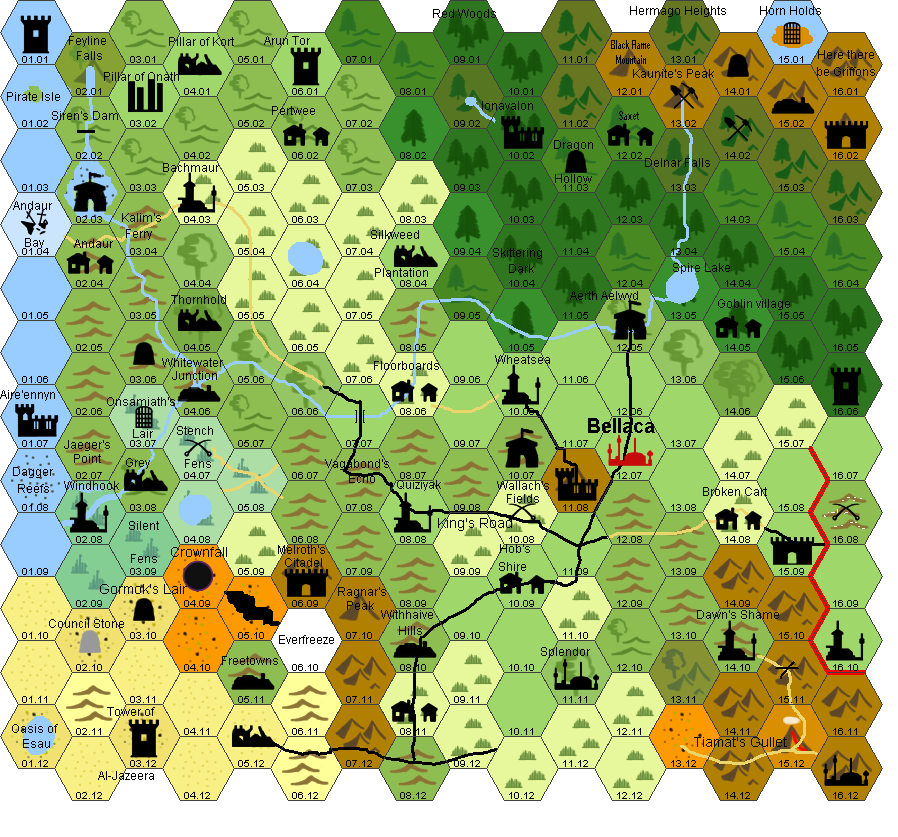
 https://blogger.googleusercontent.com/img/b/R29vZ2xl/AVvXsEinhrRvrF12gQStMKOYKDYaZUF2YoSWhLG_ztUKgObeVPSv5Ldjbgiv-8Nmd49jt0svT9J05StEp8bvqCbNzFYxGVzZSCZZ9YbaE4ICo5FvBBKBGN1N_TFO8jVotSn6NvQPfrskoDZ8t5g/s1600/Isle+of+Fire+%2526+Cruelty+Numbered+Grid.png

Dynamic vs Static

Next we ask ourselves if we want some of the objectives to be dynamic or static. A dynamic objective will change depending on whether the task is "completed", "failed" or simply "ignored". A static quest, on the other hand, simply remains frozen in time until the party walks up to it and attempts to complete it.

Most objectives are usually static, and do not change over the course of time. However, adding a few dynamics can add variety to the adventure, and offer a sense of a living, reactionary world.

If the party successfully completes an objective, one outcome triggers. If they attempt but fail, another outcome will trigger. Lastly, if the objective is ignored (and the party pursues the second or third tier of another quest), a tertiary outcome could trigger. Outcomes can be thought of as branches in a flow chart. They can lead to all-new objectives within that quest, or branch to other objectives of other quests (see below).


For our example, we will say that if the party attempts--but fails--to follow the "pirates booty" black market money (from quest 1), then the pirates grow suspicious of the party's intentions, and go underground. The party will lose the trail. The only way for them to advance further in this quest is to later succeed at the first objective of the "dead king's crown" quest (countering the theif's ambush). If successful, the party will gain information about the pirate's cove, putting it on the map.

We can also say that if the "invading marauders" are ignored, not only will the army march across the borders, they'll begin destroying outlier settlements and farms. This creates a sense of urgency for the party, and a consequence for ignoring an obvious threat to the safety of the countryside.

Lastly, we'll say that if the party successfully completes the second objective of "pirate's booty" (infiltrates the pirate's camp), they'll learn that the pirates were actually hired by the marauding army to steal the crown of the king, in an attempt to embarrass the kingdom and ruin the morale of the settlement prior to invasion.

Cross-Connecting Quests

By tying the quests together like this, the world feels more interconnected and living. Not all quests need to be woven like this, but sometimes it can add a level of depth otherwise missing. When connecting quests in this way; you can make the connections either optional or mandatory. Mandatory connections will demand that the party pursue (and complete) one of the secondary quests (at least partially) in order to advance the main quest line. The idea is to "nest" quest objectives.

Strongholds & Maps

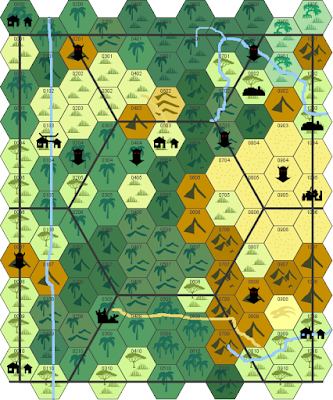
https://blogger.googleusercontent.com/img/b/R29vZ2xl/AVvXsEgLZ25u-6BwIcEI_d8Qu1OSVOpUtL1WvEqz3ATGVL8O1Iayc4BjdYmHOaGfCNLLxRY5JI5LfsC3yuzK_sERM_DaT8VkKHCCx-9T3K0N6UDZX5ONhRNknLejPIntV_enUQ6OMI4Nf21_PX5p/s400/WotRPHexcrawl.png

Next we need to draw out our map of the countryside. I usually like to have about five day's travel in any direction. I feel like this offers a big enough play area for the party to explore, but not feel like its super massive.

We want to place the landmarks the character's will be exploring in such a way that most corners of the map will get covered. Also consider objectives that are linked or related, and their spatial distance from each other. Try to think of the logical flow the party will travel as they pinball from one objective to another, or even from one quest to the next.

I also like to place a lot of detail on two main strongholds: one "good" settlement (usually a town, village or kingdom). This acts as a safe zone for the party to begin at, and return when they are injured or in need on fresh supplies. The other is a "bad" settlement. This is usually the principle dungeon. In our example, the dead king's catacombs would be our main dungeon.

The other quests, objectives, and landmarks can be discussed, but in far-less detail.

Micro Quests, Rumors & Ecology

As a final garnish, I like to add micro quests (in addition to the side quests already discussed). These help add a sense that the world is full of NPCs with real needs and struggles; separate from the main storyline. Micro quests are small objectives made up of one or two sentences. For example:
  • A merchant's wagon is stuck in the mud and needs help getting his wares to town.
  • A band of hunters got lost in the forest and need help navigating back to their camp.
  • A coven of seers wish to complete a pilgrimage to the top of a mountain, but cannot find their sacred cave; and are willing to bless anyone who assists them.
  • A vendor in town suspects a boy has been stealing from his tent shop; and is willing to pay a gold coin to anyone who can find the cut purse.
Rumors: A 1d10 list of rumors (some true, some false) that the party will hear along their travels from NPCs. These rumors add a nice flair to making the world feel real and living. Is it true a lich lives in a tower to the east? Is it real that the blood moon recedes the tide revealing a magical stone beneath the tidal waters? Could the marauders really be involved with the pirates and the recent disappearance of the king's crown?

Ecology: A 1d10 list of random landmarks, artifacts and natural phenomena. Again, this helps add a splash of color to the things the players may discover in their travels. These landmarks should help highlight past events, the regional climate, and cultural artifacts. For example, a statue of the king Tipelon could be at a crossroad, or a treasure map leading to the pirate's buried treasure hidden in the thief's camp, or relics of a past war between the kingdom's army and the marauders are half-buried on the borders of the countryside.

Conclusion

Though nothing I've written here is revolutionary, I hope it has helped you start with a framework for writing and creating your own living, breathing hex crawl. Thanks for reading!

Friday, May 26, 2017

Sphere of Existance

One of the things I never really thought about when first learning how to play RPGs was the different dimensions and spheres of existence in a game. After-all, they're usually not needed or even used in most adventures. However, having at least some understanding of the relationship between the different parts can help "explain" how certain extraordinary effects work.

In this post, I'd like to present my own take on other dimensions/realms/planes/spheres of existence. For mine, I'll call it the "hypersphere" of existence.

Six-Dimensional Space

In this hypersphere, there are six dimensions. The first three (which we'll call X, Y and Z) are the same as we normally think of them: forward-backward, left-right and up-down. The whole of the universe works within these dimensions similar to the modern theory of the universe. The universe itself is made up of a very large sphere with space, matter, energy etc. unfolding normally within its boundaries.

However, there are another three dimensions that exist as well. These dimensions are "hyperdimensions" that cannot normally be seen on a day-to-day basis (the same as three sides of a six-sided cube are always hidden from view). We'll call these dimensions A, B and C.


These hyperaxis are not contained inside a "bubble", like the rest of the universe. Instead, they ride along the surface of the universal boundary, like how we walk along the crust of the earth. On the surface of this sphere are four poles (explained below).

Elemental Poles

The first of these hyper-axis can be thought of running from west to east. Two poles inhabit the opposite sides of the sphere: the western pole is the coldest, and made of mostly solids and matter. This is where Earth exists; since the vacuum of space is cold and there is a lot of matter spread throughout.

As we travel east, we approach the second pole, which is the hottest and made of mostly energy and magic. In this pole, existence is only of a plasma of pure energy and mana. Only thoughts/souls/magic can exist in this hyper-energized state.

In-between these two poles exists a spectrum running from very-hot (fire) to cooler (gas/air), to cold (water/liquid) to very-cold (solid/earth).


Celestial Poles

From north to south are the celestial poles. The north pole is the high heavens, where pure divinity stands and the virtues of bravery, charitably, chastity, fairness, forgiveness, honesty, humility, mercy, prudence, temperance, tolerance and trust are incarnate. They permeate in the essence of all that is there. The wind sings fairness, the trees sway in tolerance and the sun shines honesty.

The south pole is the lower hells. Here, the heart of evil thrives and the vices of cowardice, selfishness, lust, prejudice, vengeance, deception, arrogance, cruelty, recklessness, indulgence, zealotry and suspicion are anthropomorphic. The darkness cloaks all in deception, the fires burn with vengeance and the ices forever freeze suspicion.

Near the equator is a mix of both celestial poles, where true neutrality exists. The universe here is completely indifferent to the good and evil happenings that erupt all around it. Instead, a true balance of nature is reached where only equilibrium exists.

In the Beginning...

At the very start of the universe, everything was infinitesimal. Similar to the big bang, all that was and ever will be was in a single point in space and time. As the great eruption occurred, all creation sprung forth. The universe now expands outwards, from a previous state of order to one of chaos. This expansion is very slow, taking place over trillions of years.

As matter moves from a stable state to a more unstable state, this expansion represents the passing of time. This third axis, the up-down axis (like jumping upwards towards the sky and back down to the ground), travels in a single direction: outwards. This is how time moves forward; marching forwards to an inevitable heat death for everything within it.

Most creatures cannot change their course of time travel because everything is being flung outwards. Over millennium, everything (including the earth, heaven, hell, etc.) will begin to break down into chaos. In this sense, everything exists in a slow spectrum of order-to-chaos (that takes place over time).

Alternate Dimensions & Timelines

Because space itself is ever-expanding; the possibilities of which direction matter can travel grows in possibilities to near-infinite the farther out from it's original source it travels. In the present, there is only one possibility: the one possibility unfolding in the present. But every second into the future, there grows more possibilities of how things could occur. For example, if reading this on a computer, you could spend the next second standing up, or remain sitting (but could not, say, suddenly appear at the nearest grocery store). However, given enough time, such possibilities become possible.

The same happens in the ever-expanding universe. The more the universe expands and the more you travel along the latitudes & longitudes, the more "out of phase" you become from the present. The same location (X, Y, Z) remains the same; but the viewer grows distance from their current world by traveling along the spectrum of possibilities. Ghosts and other ethereal creatures are in the same world as us (that is, the same X, Y, Z dimensions); only they're out of phase (by traveling along the A, B, C dimensions).

This phenomenon is the same as if you looked at the three dimensions of a cube, then slowly rotated the cube. One of the sides begins to shrink in perspective (but can still be partially seen).

Dimension / Time Walkers

Most creatures cannot walk in the hyper dimensions no more than we can walk vertically along a cliff (due to gravity keeping us firmly within our own dimensions). However, some extraordinary creatures (gods, demi-gods) have the ability to walk along these dimensions. Angels, demons, etc. can walk in this way, traveling from heaven/hell to the neutral equator. They can also travel from the aether-less pole (earth) to the mana-filled pole (aether).

Portals and gates simple allow an adventurer to step onto one of the hyper-dimensions and start walking on it as the new "down".