I'm not sure if anyone caught this, but I figured I'd share this little nugget about clerics in the Basic D&D booklet (red cover).
"...Clerics do not receive any spells until they reach 2nd level (and have proven their devotion to their god or goddess)." -B9
Interesting justification in parenthesis there. Clerics have to first go through some trial or test of faith before their deity endows them with a glimmer of their divine powers. We also see another idea on the same page:
"...Clerics are forbidden by their religious codes from using edged weapons, such as swords and arrows." -B9
I have little doubt that both quotes are simply excuses to justify mechanics set up in an effort to "balance" each class. After all, a fighter with magic powers is automatically more awesome than just a fighter, so the designers had to add artificial restrictions. But that doesn't mean we can't take something from this sentiment.
The big takeaway here is that:
- Clerics must prove their devotion to their deity before recieving bonuses (or perhaps suffering a penalty)
- Clerics are forbidden from certain actions
Next up we check out "Turn", or as it'd later be called in Rules Cyclopedia (RC) "Turning Undead".
"Clerics are very helpful when undead monsters (such as skeletons, zombies and ghouls) are encountered. When a cleric encounters an undead monster, the cleric may attempt to 'Turn' (scare) the monster instead of fighting it. If a cleric Turns an undead monster, the monster will not touch the cleric and will flee from the area if it can." -B9
Interestingly, it goes on to say "
If a cleric is successful at Turning some undead monsters, the player must roll 2d6 to find how many hit dice of undead monsters are Turned." which is different than what is found in RC, which states "
...the Dungeon Master (not the player) will roll 2d6 to determine the number of Hit Dice of undead monsters that turn away."
Breaking it all Down
The Cleric is a complicated class. It's a hybrid of sorts, really. It can fight similar to a fighter, but can cast magic similar to a Magic-User, though it has its own magic and has a special ability called "Turn" (or "Turning Undead" if you're reading RC).
The benefit we have is we can start with the red cover BD&D booklet and jump into the future by reading AD&D 2nd edition, Rules Cyclopedia, 3.x, 4E and 5E. We can see how the cleric began, conceptually, and how it changed and matured over time. In my opinion, it's more important we understand the "spirit" of the cleric and the intended flavor of the designers, more than the individual rules and score numbers (although you know I'm going to look at them anyway, so we might as well get started).
Exigences
In my own game,
Open Adventure (OA), each Archetype has a set of "exigences", which is a fancy way of saying "requirements". These actions must be performed on a daily occurrence, lest the individual powers of an archetype begin to wane. This is the same sentiment that we see with the first quote about clerics ("proving ones devotion"), but this is also found with Magic Users (in BD&D) being required to be well-rested and spend 1 hour to memorize spells. The idea in my game is that a "disciple" (the OA equivalent of a cleric) must devote 1 hour to prayer and devotion per day.
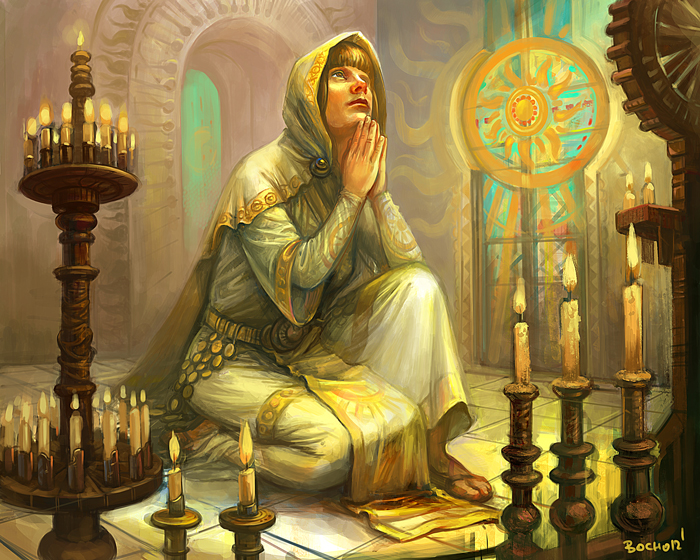
Additionally, disciples must follow three "rites" (required rituals) and abstain from three "ascetics" (forbiddings). The specifics of the rites and ascetics are left to the Game Host, and are modeled after the individual focus, alignment and wishes of the specific deity that the cleric obeys. Lastly, because in OA alignment can change based off player character actions (or the virtues & vices they obtain), disciples must remain of the same alignment as their deity. Such rules allow for a more open, free-form alternative to the idea of clerics having religious codes that suit the desires of their deity, rather than one single rigid path (e.g. clerics are forbade from using edged weapons [as a side note, if a cleric worshiped an evil deity, wouldn't they WANT you to use edged weapons to kill your enemies faster?]).
If a disciple were to lapse in any of the above requirements, the penalty they suffer is total revocation of their clerical magic. In other words, if they don't keep their patron deity happy, their deity cuts them off. But don't worry, they can get their mystical powers back after 6 hours of devotion to their deity and apology for their "sinful" ways.
Alignments
In BD&D they had the option for good clerics to be a bit naughty. They could be bad (or evil in a way) by casting a clerical spell, but in reverse. Instead of healing someone, you could cause them injury, for example. This was a great play on the polarity of good and evil (or law and chaos, as it was called back then). It hinted to the possibility of there being evil, or dark, clerics; which in turn gives raise to professions such as "necromancers" and "vodoo priests". But, in my opinion, this "alternative cleric" was never fleshed out enough.
If we fast forward into the future of D&D, especially 3.x and beyond, we see this concept comes to fruition. There are rules for good-aligned and evil-aligned clerics, and how they can channel positive and negative energy. In my opinion, basic versions of these rules should be included in BD&D since they were essentially missing from the start.
So, we have full support for good and evil clerics. But what about neutral clerics? If you're thinking to yourself "there's no such thing", you'd be wrong. In Rules Cyclopedia, in fact, it talks about how Druids are a prestige class, of sorts, derived from clerics. Since Druids are always neutral, we essentially have support (or at least tolerance) for the idea of neutrality existing within the ranks of the cleric class.
However, the way druids are handled in RC has never seemed right to me. Why must we wait until level 9 to become a druid? Even if we did, why would a cleric remain ardent to one alignment for 8 levels then decide to walk away from the cosmic battle between good and evil (not to mention the cities of men) to live among forest animals?
Instead, I propose the druid become its own class that can be pursued at level 1, and treated as a neutral cleric that devotes itself to the cosmic force(s) of the material plane. This would explain why nature and the universe are so sacred to a druid/neutral cleric, with none of the "ex pat" mid life crises.
Exorcism
The last topic we need to tackle are the special powers that these disciple/cleric characters posses. Whatever they end up being, we can conclude that they A). are either only given to a cleric if they are "ardent" in their faith and/or can be revoked if the cleric isn't walking the path right, and B). should fit the theme and focus of the cleric's alignment. That means support for good deeds as well as neutral and evil ones.
The common thread with all clerics throughout the history of D&D has been the ability to repel undead. First, the term "Turn" or "Turning Undead" should be changed. It's a confusing term that has no intrinsic meaning (that I'm aware of) outside of D&D, and must first be explained to be understood. Rather, the term "exorcism", which is a real term, is far better suited for the job.
Terminology aside, a purview of the 3.5 rules show us that there is a far more refined approach to clerical exorcism:
- Good-aligned clerics can attempt to destroy or rout (force to retreat) undead creatures
- Evil-aligned clerics can attempt to command or rebuke (force to cower) undead creatures
- Neutral-aligned clerics can mix and match between the two options
As much as I love OSR and Basic D&D, I have to say that these "new" rules are far more in spirit with what the "old" rules were trying to do. They fully support all the alignments by offering fun alternatives to evil clerics (commanding the undead rather than destroying them).
While we're discussing "turning" undead, let's talk about that "turning undead" table.
This bad boy has got to go. From a game design perspective, it's never a good idea to have such an innate common ability require such a large and verbose table. Especially when it can be condensed down into a few simple rule statements.
To start, the whole premise uses a 2d6 system. Since it's based on the idea of routing, or invoking fear and panic, in undead, we can replace this monstrosity with another system already in place: the morale system. The morale system exists to gauge a creature's willpower and whether that creature is fearful during combat (or other situations) and chooses to flee. Sound familiar? Yup, the morale system also uses a 2d6 mechanic. The two systems are practically identical.
All that has to be done is make a rule that says a cleric can force an undead to make a morale test when they attempt to exorcise them. The 2d6 roll adds the level of the cleric. If the roll is over the creature's morale number, the monster is affected. The next rule we need is to say that if the cleric's level is 3+ levels higher than that of the monster's hit dice, they are automatically destroyed (or commanded, if evil) instead of routed or rebuked. If a cleric is level 10 or above, they can affect 3d6 creatures (instead of 2d6). At level 25 they can affect 4d6 creatures, instead. Voila!
Miscellaneous
Okay I lied, exorcism isn't the last topic. I want to look at some of the differences of how clerics are handled in different versions.
Holy Symbols
To start let's talk about holy symbols. In BD&D and RC there is no rule about holy symbols being needed to exorcise undead. In fact, RC (page 14) reads "The power to turn undead is inherent in the cleric; he does not need the symbol of his faith or any other device to do it, unless the DM declares otherwise."
To me, I find this ruling a bit odd. We're all used to seeing priests and other holy men pulling out their holy symbol and using it as a ward to keep evil or undead at bay, often times in tandem with holy words. In fact, Wikipedia has this to say about exorcism:
Exorcism (from Greek ἐξορκισμός, exorkismos – binding by oath) is the religious or spiritual practice of purportedly evicting demons or other spiritual entities from a person or an area they are believed to have possessed. Depending on the spiritual beliefs of the exorcist, this may be done by causing the entity to swear an oath, performing an elaborate ritual, or simply by commanding it to depart in the name of a higher power.
Followed by this photo:
Looks like that cleric has a holy symbol in his hand, and based off the description there's some form of verbal component involved.
I feel like disallowing a holy symbol goes against the grander spirit of what a cleric is and does. To me, a cleric has always been a conduit of their deity's powers. The cleric themselves only have mystical spells because they are so faithful to their god. In turn, their deity empowers them so they can complete their quest/conquest/mission in life. Their holy symbol, in turn, is a focal point of those powers.
Now, some readers might feel compelled to point out that all of this talk about exorcism has to do with evil creatures (aka fiends) and not undead. That's a good point, but I still believe that for consistency sake, a holy symbol should be present. Looking into the future (at 3.x D&D) we see that exact ruling being enacted, whereas holy symbols become a requirement to "turn" undead.
Affected Creatures
Another interesting difference between "old school" D&D and "new school" is how they handled which creatures are routed and which are not (since you might roll X, where X is less-than the total hit dice of undead creatures within range at the time of the exorcism). In BD&D it states that the lowest level creatures (such as skeletons) are routed first, then the extra points are distributed to higher leveled creatures. Presumably this is to emulate the weaker-minded creatures being more vulnerable to the effects of exorcism.
In newer versions of D&D, however, it says that the creatures physically closest to the cleric are turned first. This, I assume, is to emulate a "blast" effect with the exorcism; as if it is exploding outwards from the cleric's body or holy symbol.
Personally, I think both can be used, in combination. The rules state that after a cleric exorcises undead, they roll 2d6 to determine how many levels/hit dice worth of undead are routed. A simple ruling would be to say start with the lowest leveled ones. If there is still a tie, or you need to know which one of that group to begin with, start with those closest to the cleric. If there's still a tie, the cleric gets to choose.
Conclusion
Clerics can be a lot of fun, but I don't think there's a perfect version of D&D out there. Instead, it behooves us to take the best parts of each version and combine them to paint a picture of what we think the designers had in mind, as well as keep the effects grounded in historical fact (based on tradition and mythology).